1. Overview
Motion is the study of how objects move through space and time. Understanding motion allows us to predict where an object will be in the future and how forces like gravity and air resistance affect its travel, which is essential for everything from road safety to space exploration.
Key Definitions
- Speed: The distance travelled per unit time (a scalar quantity).
- Velocity: The speed of an object in a specific direction (a vector quantity).
- Distance: The total length of the path travelled by an object.
- Acceleration: The rate of change of velocity per unit time.
- Gradient: The steepness of a slope on a graph, calculated as "rise over run."
- Terminal Velocity: The constant maximum velocity reached by a falling object when the upward force of resistance equals the downward force of weight.
Core Content
Speed and Velocity
Speed tells us how fast an object is moving, while velocity includes the direction.
- Speed Equation:
- Average Speed: When an object changes speed during a journey, we calculate the average by dividing the total distance by the total time taken.
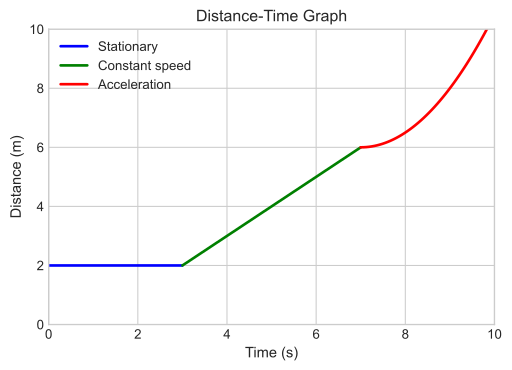
Distance-Time (D-T) Graphs
These graphs show how far an object has moved from a starting point over time.
- At Rest: A horizontal flat line (distance is not changing).
- Constant Speed: A straight diagonal line.
- Acceleration: The line curves upwards (getting steeper).
- Deceleration: The line curves downwards (getting flatter).
- Calculating Speed: The gradient (slope) of a straight-line section equals the speed.
Speed-Time (S-T) Graphs
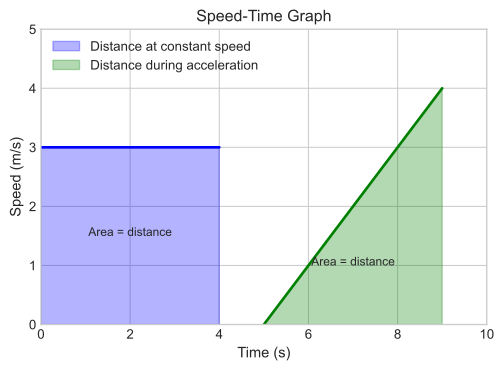
These graphs show how the speed of an object changes over time.
- At Rest: A horizontal line on the x-axis (speed = 0).
- Constant Speed: A horizontal line above the x-axis.
- Acceleration: A line sloping upwards.
- Deceleration: A line sloping downwards.
- Calculating Distance: The area under the line of a speed-time graph represents the total distance travelled.
Free Fall
Near the Earth's surface, all objects fall with the same constant acceleration if we ignore air resistance. This is called the acceleration of free fall ().
- Value of : approximately .
Worked Example (Core): A car travels 150 meters in 10 seconds. Calculate its speed.
Extended Content (Extended Curriculum Only)
Acceleration
Acceleration is the change in velocity per unit time.
- Equation: (where is the change in velocity: ).
- Deceleration: This is simply negative acceleration. If an object slows down, its acceleration value will be negative (e.g., ).
Speed-Time Graphs (Advanced)
- Gradient: The gradient of a speed-time graph represents the acceleration.
- Constant Acceleration: A straight diagonal line.
- Changing Acceleration: A curved line. If the curve gets steeper, acceleration is increasing; if it levels off, acceleration is decreasing.
Falling Objects and Terminal Velocity
When an object falls in a uniform gravitational field:
- Initial Fall: The only force is Weight. The object accelerates at ().
- Increasing Speed: As speed increases, Air Resistance (drag) increases. This reduces the resultant force, so acceleration decreases.
- Terminal Velocity: Eventually, Air Resistance increases until it equals the Weight. The forces are balanced (resultant force = 0). The object stops accelerating and falls at a constant terminal velocity.
Worked Example (Extended): A sprinter accelerates from to in seconds. Calculate the acceleration.
Key Equations
| Concept | Equation | Symbols & Units |
|---|---|---|
| Speed | ||
| Avg. Speed | Units: | |
| Acceleration |
Common Mistakes to Avoid
- ❌ Wrong: Saying a scalar (like speed) has a direction.
- ✓ Right: Speed is just a magnitude; only vectors (like velocity) have direction.
- ❌ Wrong: Believing an object's weight affects how hard it is to move it horizontally (inertia).
- ✓ Right: Mass—not weight—determines resistance to acceleration (inertia). Weight is a vertical force due to gravity.
- ❌ Wrong: Confusing Distance-Time graphs with Speed-Time graphs.
- ✓ Right: Always check the Y-axis label. A flat line means "stopped" on a D-T graph, but "constant speed" on an S-T graph.
Exam Tips
- Show Your Units: Always include for speed and for acceleration. You can lose easy marks by forgetting them.
- The "Area" Trick: In any exam question asking for distance from a speed-time graph, immediately look for shapes (rectangles and triangles) under the line and calculate their area.
- Gradient Calculation: When calculating the gradient, use as much of the line as possible (draw a large triangle) to improve accuracy.
Exam-Style Questions
Practice these original exam-style questions to test your understanding. Each question mirrors the style, structure, and mark allocation of real Cambridge 0625 Theory papers.
Exam-Style Question 1 — Short Answer [4 marks]
Question:
A student walks to school. The journey can be divided into two sections:
- Section 1: Walking at a constant speed of 1.5 m/s for 600 s.
- Section 2: Walking at a constant speed of 1.0 m/s for 300 s.
(a) Calculate the total distance walked by the student. [3]
(b) Calculate the student's average speed for the entire journey. [1]
Worked Solution:
(a)
Calculate distance for Section 1: Using the formula distance = speed x time for the first section.
Calculate distance for Section 2: Using the formula distance = speed x time for the second section.
Calculate total distance: Adding the distances from both sections.
How to earn full marks:
- 1 mark for correct substitution into for section 1.
- 1 mark for correct substitution into for section 2.
- 1 mark for the final answer with the correct unit.
(b)
- Calculate average speed: Using the formula average speed = total distance / total time.
How to earn full marks:
- 1 mark for the correct answer with the correct unit. ECF allowed if the total distance from part (a) is incorrect.
Common Pitfall: Remember that average speed is calculated using the total distance and total time. Don't just average the two speeds given in the question; that's a common mistake!
Exam-Style Question 2 — Extended Response [8 marks]
Question:
A remote-controlled car is tested on a straight track. The car starts from rest and accelerates uniformly for 4 seconds, reaching a speed of 6 m/s. It then travels at a constant speed for another 6 seconds before decelerating uniformly to rest in 2 seconds.
(a) Sketch a speed-time graph for the motion of the car. [3]
(b) Calculate the acceleration of the car during the first 4 seconds. [2]
(c) Calculate the total distance travelled by the car. [3]
Worked Solution:
(a)
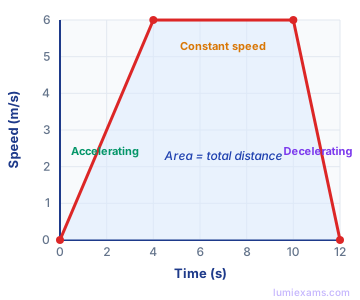 *Sketching the speed-time graph, showing each phase of the motion.*
How to earn full marks:
- 1 mark for correctly labelled axes with units.
- 1 mark for correct shape of the graph (acceleration, constant speed, deceleration).
- 1 mark for correct values on the graph (4s, 6s, 2s, 6 m/s).
(b)
- Calculate acceleration: Using the formula acceleration = change in velocity / time.
How to earn full marks:
- 1 mark for correct substitution into the formula.
- 1 mark for the correct answer with the correct unit.
(c)
Calculate the distance during acceleration (area of the triangle): Finding the area under the graph during acceleration.
Calculate the distance during constant speed (area of the rectangle): Finding the area under the graph during constant speed.
Calculate the distance during deceleration (area of the triangle): Finding the area under the graph during deceleration.
Calculate the total distance: Adding the distances from each phase.
How to earn full marks:
- 1 mark for calculating the distance during acceleration or deceleration.
- 1 mark for calculating the distance during constant speed.
- 1 mark for the correct total distance with the correct unit. ECF allowed for incorrect distances from previous steps.
Common Pitfall: When finding the total distance from a speed-time graph, remember to calculate the area under each section of the graph. Many students forget to use the 1/2 factor when calculating the area of the triangles representing acceleration and deceleration.
Exam-Style Question 3 — Short Answer [6 marks]
Question:
A small metal ball is dropped from a height and falls vertically towards the ground.
(a) State the value of the acceleration of free fall, , near the Earth's surface, including its unit. [1]
(b) Describe how the speed of the ball changes as it falls, assuming air resistance is negligible. [2]
(c) Explain why the actual acceleration of the ball will be less than when air resistance is considered. [3]
Worked Solution:
(a)
- Value of : Stating the value of acceleration due to gravity.
How to earn full marks:
- 1 mark for the correct value and unit.
(b)
Speed increases. Stating the speed increases.
Speed increases at a constant rate. Stating the speed increases at a constant rate due to constant acceleration.
How to earn full marks:
- 1 mark for stating the speed increases.
- 1 mark for stating the rate of increase is constant.
(c)
Air resistance acts upwards. Stating that air resistance opposes the motion.
Air resistance reduces the net force on the ball. Explaining that air resistance reduces the resultant force acting on the ball.
Resultant force is reduced so acceleration is reduced (). Relating reduced net force to reduced acceleration using Newton's Second Law.
How to earn full marks:
- 1 mark for stating air resistance acts upwards.
- 1 mark for stating air resistance reduces the net force.
- 1 mark for relating the reduced net force to reduced acceleration.
Common Pitfall: It's crucial to remember that air resistance opposes the motion of the ball. This means the net force acting on the ball is reduced, leading to a smaller acceleration than 'g'. Don't forget to link the reduced force to reduced acceleration using F=ma.
Exam-Style Question 4 — Extended Response [10 marks]
Question:
A cyclist is riding along a straight, horizontal road. The cyclist starts from rest and accelerates uniformly to a speed of 8 m/s in 5 seconds. The cyclist then travels at a constant speed of 8 m/s for 10 seconds. Finally, the cyclist applies the brakes and decelerates uniformly to rest in a further 4 seconds.
(a) Calculate the acceleration of the cyclist during the first 5 seconds. [2]
(b) Calculate the total distance travelled by the cyclist during the entire journey. [4]
(c) The mass of the cyclist and the bicycle is 70 kg. Calculate the average force exerted by the brakes during the final 4 seconds. [4]
Worked Solution:
(a)
- Calculate acceleration: Using the formula acceleration = change in velocity / time.
How to earn full marks:
- 1 mark for correct substitution into the formula.
- 1 mark for the correct answer with the correct unit.
(b)
Calculate the distance during acceleration (area of the triangle): Finding the area under the graph during acceleration.
Calculate the distance during constant speed (area of the rectangle): Finding the area under the graph during constant speed.
Calculate the distance during deceleration (area of the triangle): Finding the area under the graph during deceleration.
Calculate the total distance: Adding the distances from each phase.
How to earn full marks:
- 1 mark for calculating the distance during acceleration or deceleration.
- 1 mark for calculating the distance during constant speed.
- 1 mark for adding all three distances.
- 1 mark for the correct total distance with the correct unit. ECF allowed for incorrect distances from previous steps.
(c)
Calculate the deceleration during the final 4 seconds: Using the formula acceleration = change in velocity / time.
Calculate the force exerted by the brakes: Using Newton's Second Law, F = ma.
How to earn full marks:
- 1 mark for correct substitution into the formula for deceleration.
- 1 mark for correct calculation of deceleration (magnitude only).
- 1 mark for correct substitution into F=ma.
- 1 mark for the correct force with the correct unit. ECF allowed for an incorrect deceleration from the previous step (magnitude only).
Common Pitfall: When calculating the braking force, make sure you use the magnitude of the deceleration (i.e., ignore the negative sign) in the F=ma equation. The question asks for the force exerted, which is a positive value. Also, remember to always include the correct SI unit (Newtons) in your final answer.