1. Overview
Radioactive decay is a random process, meaning we cannot predict when a single nucleus will decay. However, because samples contain billions of atoms, we can use the concept of half-life to predict how the overall activity of a sample decreases over time. Understanding half-life is crucial for using radiation safely in medicine, industry, and the home.
Key Definitions
- Half-life (): The time taken for half the nuclei of a specific isotope in a sample to decay. Alternatively: the time taken for the activity (or count rate) of a sample to decrease to half its initial value.
- Activity: The rate at which a source of unstable nuclei decays, measured in Becquerels (Bq). 1 Bq = 1 decay per second.
- Isotope: Atoms of the same element with the same number of protons but different numbers of neutrons.
- Count-rate: The number of decays detected per second by a device (like a Geiger-Müller tube).
- Background Radiation: The low-level radiation present at all times from natural (e.g., rocks, cosmic rays) and man-made sources.
Core Content
Understanding Half-life Since decay is exponential, a substance never "runs out" of radioactivity linearly. Instead, it halves every set period of time.
- After 1 half-life: 50% remains (1/2)
- After 2 half-lives: 25% remains (1/4)
- After 3 half-lives: 12.5% remains (1/8)
Using Decay Curves A decay curve is a graph showing Activity (y-axis) against Time (x-axis).
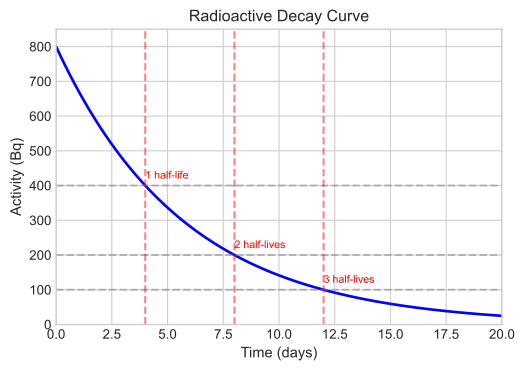
To find half-life from a graph:
- Pick a starting activity on the y-axis.
- Find the time value for that activity.
- Divide the starting activity by 2.
- Find the new time value for this halved activity.
- The difference between these two times is the half-life.
Worked Example (Core) Question: A sample has an initial activity of 1200 Bq. Its half-life is 5 minutes. What is the activity after 15 minutes?
- Calculate the number of half-lives: half-lives.
- Halve the activity three times:
- 1200 600 (1st half-life)
- 600 300 (2nd half-life)
- 300 150 Bq (3rd half-life)
Extended Content (Extended Curriculum Only)
Calculating Half-life with Background Radiation In real experiments, a Geiger-Müller tube detects both the source and the background radiation. To find the true half-life, you must subtract the background radiation first.
Formula:
Worked Example (Extended) Question: The background radiation is 20 counts/min. A source measures 180 counts/min initially. After 4 hours, the source measures 60 counts/min. Calculate the half-life.
- Find initial corrected activity: counts/min.
- Find final corrected activity: counts/min.
- Determine half-lives: (This is 2 half-lives).
- Calculate duration: 2 half-lives = 4 hours, so 1 half-life = 2 hours.
Applications of Isotopes The choice of isotope depends on its penetrating power and its half-life.
| Application | Radiation Type | Preferred Half-life | Reasoning |
|---|---|---|---|
| Smoke Alarms | Alpha | Long (years) | Alpha is easily blocked by smoke; long half-life means you don't need to replace the source often. |
| Irradiating Food | Gamma | Long | Gamma kills bacteria/mold throughout the food; long half-life provides a consistent dose over time. |
| Sterilising Equipment | Gamma | Long | Gamma penetrates packaging to kill bacteria on medical tools; long half-life ensures the machine stays effective. |
| Thickness Control | Beta | Long | Alpha is too weak (blocked by paper); Gamma is too strong. Beta absorption changes based on thickness; long half-life ensures changes in count-rate are due to metal thickness, not source decay. |
| Cancer Treatment | Gamma | Short/Long | Focused beams kill tumors. If injected, a short half-life is needed to limit the dose to the patient. |
| Medical Diagnosis | Gamma | Very Short (hours) | Must be penetrating to leave the body; short half-life ensures the patient isn't radioactive for long. |
Key Equations
- Number of half-lives ():
- Remaining Activity ( ): (where is initial activity)
- Corrected Activity:
- Units: Activity = Becquerels (Bq); Time = Seconds, minutes, hours, or years.
Common Mistakes to Avoid
- ❌ Wrong: Assuming a substance decays at a constant linear rate (e.g., if 100g decays to 50g in 10 mins, it will all be gone in 20 mins).
- ✓ Right: Decay is exponential. After 20 minutes, 25g would remain (half of 50g).
- ❌ Wrong: Calculating half-life by simply dividing the total time by the starting activity.
- ✓ Right: Use the total time to find how many "halving cycles" occurred.
- ❌ Wrong: Forgetting to subtract background radiation before halving the numbers in extended questions.
- ✓ Right: Subtract background radiation from all readings first, then perform the half-life calculation.
Exam Tips
- Read the Graph Axes: Ensure you are looking at "Activity" or "Count-rate" and check the units for time (hours vs. days).
- The "Half-way" Check: If a question asks for the activity after a certain time, always draw a quick arrow diagram () to keep track of how many half-lives have passed.
- Application Logic: When asked why a specific isotope is used, always mention two things: its penetrating power (can it get through the material?) and its half-life (safety vs. convenience).
Exam-Style Questions
Practice these original exam-style questions to test your understanding. Each question mirrors the style, structure, and mark allocation of real Cambridge 0625 Theory papers.
Exam-Style Question 1 — Short Answer [5 marks]
Question:
A sample of radioactive iodine-131 is used in a hospital to treat thyroid cancer. Iodine-131 has a half-life of 8.0 days.
(a) Define the term half-life. [2]
(b) A sample of iodine-131 has an initial activity of 800 Bq. Calculate the activity of the sample after 24 days. [3]
Worked Solution:
(a)
- The time taken for half of the radioactive nuclei in a sample to decay. [Definition of half-life]
How to earn full marks:
- Correctly state "time taken", "half", and "decay" or "disintegrate" in the definition.
- Mention "nuclei" or "atoms" or "original sample" in the definition.
(b)
- Calculate the number of half-lives in 24 days. [Determines the number of half-lives]
- Calculate the activity after 3 half-lives. [Reduces the activity by a factor of 2 for each half-life]
How to earn full marks:
- Correctly calculate the number of half-lives (3).
- Divide the initial activity by or 8.
- State the final answer with the correct unit.
Common Pitfall: A common mistake is to assume that the activity decreases linearly with time. Remember that radioactive decay is an exponential process, so the activity halves after each half-life, not by a constant amount. Also, be sure to include the correct unit (Bq) in your final answer.
Exam-Style Question 2 — Short Answer [6 marks]
Question:
Americium-241 is a radioactive isotope used in smoke detectors. It emits alpha particles.
(a) State two properties of alpha particles. [2]
(b) Explain why a radioactive isotope that emits alpha particles is suitable for use in a smoke detector. [2]
(c) The half-life of Americium-241 is 432 years. Suggest why it is suitable for use in a smoke detector that is expected to last for 10 years. [2]
Worked Solution:
(a)
- Alpha particles are helium nuclei. [States the composition of alpha particles]
- Alpha particles have a positive charge (+2). [States the charge of alpha particles]
How to earn full marks:
- Any two of: helium nucleus, positive charge, strongly ionising, short range in air, stopped by paper, etc.
(b)
- Alpha particles ionise the air inside the detector. [Explains the ionization process]
- Smoke particles absorb the alpha particles, reducing the ionisation and triggering the alarm. [Explains how smoke affects the alpha particles and activates the alarm]
How to earn full marks:
- Mention that alpha particles ionise the air.
- Mention that smoke particles absorb/block the alpha particles, reducing ionisation and triggering the alarm.
(c)
- After 10 years, a negligible amount of the Americium-241 will have decayed. [States the decay rate is very slow]
- The activity of the Americium-241 will remain approximately constant, ensuring the detector functions correctly for its expected lifespan. [Explains why the slow decay rate is beneficial]
How to earn full marks:
- State that a negligible amount decays in 10 years.
- Explain that the activity remains nearly constant, so the detector works effectively.
Common Pitfall: Students sometimes struggle to explain the connection between a long half-life and the suitability for smoke detectors. The key is to realize that a very long half-life means the activity remains nearly constant over the device's lifespan, ensuring reliable operation. Don't just say "it lasts a long time"; explain why that's important.
Exam-Style Question 3 — Extended Response [7 marks]
Question:
A scientist is investigating the use of a radioactive isotope to measure the thickness of aluminium sheets produced in a factory. The isotope emits beta particles.
(a) Describe how the scientist could use the radioactive isotope and a detector to measure the thickness of the aluminium sheets. Include a diagram in your answer. [4]
(b) Explain why an isotope that emits alpha particles would not be suitable for this application. [2]
(c) The scientist measures the count rate detected through an aluminium sheet of a certain thickness. The count rate is 640 counts per minute (cpm). Without the aluminium sheet, the count rate is 5120 cpm. The half-thickness of aluminium for these beta particles is 2.0 mm (the thickness of aluminium that reduces the count rate by half). Calculate the thickness of the aluminium sheet. [1]
Worked Solution:
(a)
- A source of beta radiation is placed on one side of an aluminium sheet. A detector is placed on the opposite side. The aluminium sheet is between the source and the detector. Label the source, sheet, and detector.[Diagram shows the setup]
- The radioactive source emits beta particles. [States the radiation type]
- The aluminium sheet absorbs some of the beta particles. [Explains the absorption process]
- The detector measures the count rate of the beta particles that pass through the sheet. A thicker sheet will absorb more beta particles, resulting in a lower count rate. [Explains how the count rate relates to thickness]
How to earn full marks:
- Diagram must show the source, sheet, and detector in the correct arrangement, and be labelled.
- State that beta particles are emitted.
- State that the aluminium sheet absorbs beta particles.
- Explain that a lower count rate indicates a thicker sheet.
(b)
- Alpha particles have a very short range in air and are easily absorbed by even thin materials. [States the limited penetration of alpha particles]
- Alpha particles would be completely absorbed by any aluminium sheet, regardless of its thickness. Therefore, the detector would always read zero, and it would be impossible to measure the thickness. [Explains why alpha particles are unsuitable]
How to earn full marks:
- State that alpha particles have a short range and are easily absorbed.
- Explain that all alpha particles would be absorbed, making thickness measurement impossible.
(c)
- Determine the number of half-thicknesses required to reduce the count rate from 5120 cpm to 640 cpm. This is 3 half-thicknesses.
- Calculate the total thickness.
How to earn full marks:
- Correctly determine the number of half-thicknesses (3).
- Multiply the number of half-thicknesses by the half-thickness value (2.0 mm).
- State the final answer with the correct unit.
Common Pitfall: Many students forget to include a labeled diagram in part (a), even when explicitly asked. Also, in part (c), make sure you understand the concept of "half-thickness" and how it relates to the number of half-lives. Don't just divide the initial count rate by the half-thickness value.
Exam-Style Question 4 — Extended Response [9 marks]
Question:
A medical technician is preparing a sample of technetium-99m (Tc-99m) for use in a medical scan. Tc-99m is a radioactive isotope that emits gamma radiation.
(a) State two properties of gamma radiation. [2]
(b) Explain why gamma radiation, rather than alpha or beta radiation, is used for medical scans. [3]
(c) Tc-99m has a half-life of 6.0 hours. The technician needs to prepare a sample with an activity of 40 MBq (megabecquerels) at 08:00. Calculate the activity of the Tc-99m sample that the technician needs to prepare at 02:00 (6 hours earlier). [4]
Worked Solution:
(a)
- Gamma radiation is an electromagnetic wave. [States the nature of gamma radiation]
- Gamma radiation has no charge. [States the charge of gamma radiation]
How to earn full marks:
- Any two of: electromagnetic wave, high energy, no mass, no charge, highly penetrating, travels at the speed of light.
(b)
- Alpha radiation is strongly ionising and has a short range, so it would be absorbed by the body before reaching the detector. [Explains why alpha radiation is unsuitable]
- Beta radiation is also strongly ionising and has a limited range, so it would also be absorbed by the body. [Explains why beta radiation is unsuitable]
- Gamma radiation is weakly ionising and highly penetrating, so it can pass through the body and be detected externally, allowing internal organs to be imaged. [Explains why gamma radiation is suitable]
How to earn full marks:
- Explain that alpha radiation is absorbed due to its short range.
- Explain that beta radiation is absorbed due to its limited range.
- Explain that gamma radiation is penetrating and can be detected externally.
(c)
- Calculate the number of half-lives between 02:00 and 08:00. [Determines the number of half-lives]
- Calculate the required activity at 02:00. [Multiplies the activity by 2 to account for one half-life]
How to earn full marks:
- Correctly calculate the number of half-lives (1).
- Multiply the activity at 08:00 by 2.
- State the final answer with the correct unit.
Common Pitfall: A common mistake in part (c) is to divide the activity by 2 instead of multiplying, because students forget that you're calculating the initial activity needed to reach a certain activity later. Also, remember that MBq stands for megabecquerels, so the unit is already correct and doesn't need any further conversion.