1. Overview
Graphs in practical situations allow us to visually represent and analyze real-world relationships between two or more variables. This topic covers interpreting and drawing graphs related to travel (distance-time and speed-time graphs) and conversions (e.g., currency, temperature). You'll learn to extract key information like speed, acceleration, and distance traveled directly from the graphs. This is a core skill applicable across many subjects, including physics and economics.
Key Definitions
- Conversion Graph: A linear graph used to convert one unit of measurement to another (e.g., Celsius to Fahrenheit or Currency).
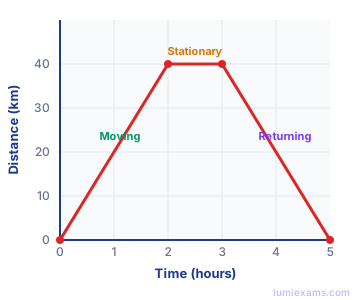
- Distance-Time Graph: A graph showing the distance traveled over a period of time. The gradient represents the speed.
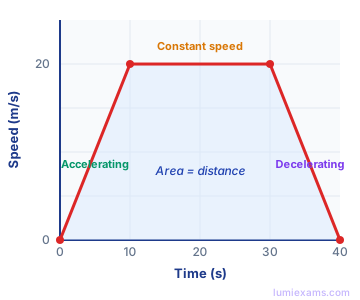
- Speed-Time Graph: A graph showing how speed changes over time. The gradient represents acceleration.
- Stationary: Not moving; represented by a horizontal line on a distance-time graph.
- Constant Speed: Moving at a steady rate; represented by a straight sloping line on a distance-time graph or a horizontal line on a speed-time graph.
- Gradient: The "steepness" of a line, calculated as .
Core Content
Conversion Graphs
Conversion graphs are straight lines passing through the origin (unless there is a fixed starting cost). To use them, find the value you know on one axis, move vertically/horizontally to the line, and read the corresponding value on the other axis.
Worked example 1 — Currency Conversion
Question: A conversion graph converts Euros (€) to Japanese Yen (¥). The graph passes through the points (0, 0) and (5, 650). Convert €35 to ¥.
- Find the conversion rate: €5 = ¥650
- Divide both sides by 5 to find the value of €1: €5 ÷ 5 = ¥650 ÷ 5
- Simplify: €1 = ¥130
- Multiply both sides by 35 to find the value of €35: €35 = ¥130 × 35
- Calculate: €35 = ¥4550
Answer: €35 = ¥4550
Distance-Time Graphs
- Horizontal line: The object is stationary (distance is not changing).
- Straight sloping line: The object is moving at a constant speed.
- Steeper gradient: The object is moving faster.
- Negative gradient: The object is returning to the starting point.
Worked example 2 — Calculating Speed
Question: A cyclist travels 45 km in 2 hours and 15 minutes. Calculate their average speed in km/h.
- Formula:
- Convert 15 minutes to hours:
- Total time in hours:
- Substitute values into the formula:
- Calculate:
Answer: The cyclist's average speed is 20 km/h.
Worked example 3 — Distance-Time Graph Interpretation
Question: A distance-time graph shows a person travelling from home to a shop and back. The first section is a straight line from (0,0) to (1,4). The second section is a horizontal line from (1,4) to (1.5,4). The third section is a straight line from (1.5,4) to (3,0). a) How far is the shop from home? b) How long did the person spend at the shop? c) What was the person's speed on the return journey?
a) The shop is the furthest point from home. This is 4 km (read off the y-axis at the highest point). Answer: 4 km
b) The person was stationary between 1 hour and 1.5 hours. Time spent at the shop = 1.5 - 1 = 0.5 hours. Answer: 0.5 hours (30 minutes)
c) The return journey is from (1.5,4) to (3,0). Distance = 4 km. Time = 3 - 1.5 = 1.5 hours. Speed = Distance / Time = 4 / 1.5 = 2.666... km/h Answer: 2.67 km/h (to 3 s.f.)
Extended Content (Extended Only)
Speed-Time Graphs: Acceleration
The gradient of a speed-time graph represents the acceleration.
- Positive gradient: Acceleration (speeding up).
- Zero gradient (horizontal line): Constant speed (zero acceleration).
- Negative gradient: Deceleration (slowing down).
Worked example 4 — Finding Acceleration
Question: A car accelerates from to in 6 seconds. Calculate the acceleration.
Answer: The acceleration is 2 m/s².
Distance as Area Under the Graph
To find the total distance traveled on a speed-time graph, calculate the area between the line and the x-axis.
Worked example 5 — Area Calculation
Question: A motorcycle accelerates from rest to in 8 seconds, maintains that speed for 12 seconds, and then decelerates to a stop in 5 seconds. Calculate the total distance traveled.
- Part 1 (Triangle: Acceleration):
- Part 2 (Rectangle: Constant Speed):
- Part 3 (Triangle: Deceleration):
- Total Distance:
Answer: The total distance traveled is 462.5 m.
Tip: You can also use the Area of a Trapezium formula: .
Worked example 6 — Combining Speed-Time Graph Skills
Question: A speed-time graph shows a car accelerating uniformly from rest to 15 m/s in 10 seconds. It then travels at a constant speed for 20 seconds before decelerating uniformly to rest in a further 5 seconds. a) Calculate the acceleration during the first 10 seconds. b) Calculate the deceleration during the last 5 seconds. c) Calculate the total distance travelled.
a) Acceleration = Change in speed / Time Acceleration = (15 - 0) / 10 Acceleration = 1.5 m/s² Answer: 1.5 m/s²
b) Deceleration = Change in speed / Time Deceleration = (0 - 15) / 5 Deceleration = -3 m/s² (The negative sign indicates deceleration) Answer: -3 m/s²
c) Total distance = Area under the graph. The graph is a trapezium. Area = 0.5 * (a + b) * h, where a = 20, b = 35, h = 15 Area = 0.5 * (20 + 35) * 15 Area = 0.5 * 55 * 15 Area = 412.5 m Answer: 412.5 m
Key Equations
| Concept | Equation | Units (Typical) | Notes |
|---|---|---|---|
| Speed | or | ||
| Acceleration | |||
| Average Speed | |||
| Area of Triangle | (Distance) | ||
| Area of Trapezium | (Distance) |
Note: = final speed, = initial speed.
Common Mistakes to Avoid
- ❌ Wrong: Calculating average speed by simply averaging the speeds from different parts of the journey.
- ✅ Right: Always calculate average speed using the formula: for the entire journey.
- ❌ Wrong: Forgetting to include stationary time (e.g., rest stops) when calculating total travel time, leading to an incorrect average speed.
- ✅ Right: Carefully read the problem and include all stationary periods in your total time calculation. For example, if a train stops for 10 minutes at a station, add that 10 minutes to the total time.
- ❌ Wrong: Confusing distance-time graphs and speed-time graphs. A horizontal line represents different things on each graph.
- ✅ Right: Always check the labels on the axes. On a distance-time graph, a horizontal line means the object is stationary. On a speed-time graph, a horizontal line means the object is moving at a constant speed.
- ❌ Wrong: Not paying attention to units, especially when converting between minutes and hours.
- ✅ Right: If the time is given in minutes but the speed is required in km/h, convert the minutes to hours before calculating the speed. For example, 30 minutes is 0.5 hours.
- ❌ Wrong: Forgetting to square the units for acceleration.
- ✅ Right: Acceleration is measured in units like m/s².
Exam Tips
- Command Words:
- "Describe the motion": Use precise terms like "constant acceleration," "stationary," "uniform speed," or "deceleration." Provide numerical values where possible (e.g., "constant speed of 10 m/s").
- "Calculate the gradient": This usually implies finding speed (on a distance-time graph) or acceleration (on a speed-time graph). Remember to include the correct units in your answer.
- Units: markers often provide time in minutes but require speed in km/h. Always convert minutes to hours by dividing by 60 ().
- Calculator vs Non-Calculator: In the calculator paper, use the formula to save time on speed-time distance questions. In non-calculator sections, splitting the shape into rectangles and triangles is often safer to avoid mental math errors.
- Drawing Graphs: Use a sharp pencil and a ruler. Points are usually given a tolerance of . Ensure your line of best fit (if required) has an equal distribution of points above and below.
- Underline Key Information: Before attempting a question, underline the key numbers and units provided in the problem statement. This helps prevent misreading values from the graph or using the wrong units in your calculations.