1. Overview
This topic explores how groups of organisms of the same species interact within their environment and with other species. Understanding population dynamics is essential for managing natural resources, predicting the impact of human activity on ecosystems, and implementing effective conservation strategies.
Key Definitions
- Population: A group of organisms of one species, living in the same area, at the same time.
- Community: All of the populations of different species in an ecosystem.
- Ecosystem: A unit containing the community of organisms and their environment (abiotic factors), interacting together.
- Limiting Factor: An environmental factor (such as food or space) that restricts the growth, abundance, or distribution of a population.
- Carrying Capacity: The maximum population size of a species that an environment can sustain indefinitely.
Core Content
Factors Affecting Population Growth
The rate at which a population grows is determined by the balance between the birth rate and the death rate. Several key factors limit how fast a population can increase:
- Food Supply: More food allows for higher survival rates and more successful reproduction.
- Competition: Organisms compete for resources like light, water, and nesting sites. Competition can be between members of the same species (intraspecific) or different species (interspecific).
- Predation: An increase in the number of predators will increase the death rate of the prey population.
- Disease: Pathogens spread more easily in crowded populations, increasing the death rate.
The Sigmoid Curve of Population Growth
When a population is introduced to a new environment with limited resources, it follows a specific "S-shaped" growth pattern known as a sigmoid curve.
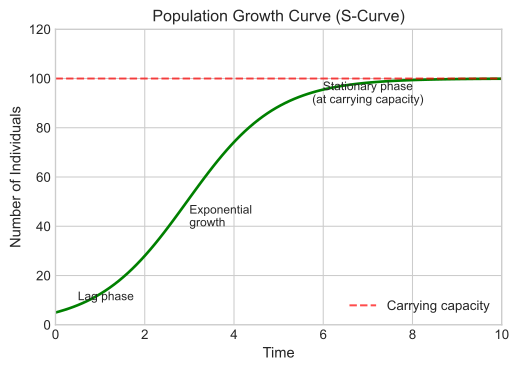
The Four Phases:
- Lag Phase: The initial period where the population size is small and growth is slow as organisms adapt to their new environment.
- Exponential (Log) Phase: The population grows rapidly. Resources are abundant, and the birth rate significantly exceeds the death rate.
- Stationary Phase: The growth rate slows down and the population size stabilizes. The birth rate equals the death rate.
- Death Phase: The population size begins to decrease. This happens when resources run out or waste products become toxic.
Extended Content (Extended Only)
Explaining the Sigmoid Curve via Limiting Factors
In the extended curriculum, you must explain why the phases of the sigmoid curve occur by referring to limiting factors.
1. Lag Phase
- Reasoning: Growth is slow because there are few reproductive individuals. Organisms may be preparing for growth by synthesizing enzymes or finding mates.
2. Exponential (Log) Phase
- Reasoning: There are no limiting factors yet. The birth rate is at its maximum because food is plentiful, there is little competition, and space is available.
3. Stationary Phase
- Reasoning: The population has reached the carrying capacity of the environment. Limiting factors (e.g., lack of food, accumulation of metabolic waste, or lack of space) mean that the death rate increases until it equals the birth rate.
4. Death Phase
- Reasoning: Limiting factors become severe. For example, in a closed environment (like bacteria in a flask), food runs out and toxic waste (like CO2 or ethanol) builds up to lethal levels. The death rate exceeds the birth rate.
Key Equations
While Biology is less math-heavy than Physics, you may be asked to calculate population changes.
1. Population Growth Rate
2. Percentage Change
- Note: Use this when asked to calculate the percentage increase in a population between two years (e.g., from 52.0 to 100.0 individuals).
Common Mistakes to Avoid
- ❌ Wrong: Defining a population as "all the animals in an area."
- ✅ Right: A population must be specified as "one species" living in the "same area" at the "same time."
- ❌ Wrong: Thinking the "Stationary Phase" means no organisms are being born.
- ✅ Right: In the stationary phase, organisms are still being born, but the birth rate is exactly balanced by the death rate.
- ❌ Wrong: Forgetting the "abiotic" (non-living) part of an ecosystem.
- ✅ Right: An ecosystem includes both the community (biotic) and the environment (abiotic).
Exam Tips
- Command Words:
- "State": Give a brief name or factor (e.g., "State two factors affecting growth" -> "Food and Predation").
- "Describe": Tell the examiner what is happening on a graph (e.g., "The population increases from 10.0 to 200.0 between day 1 and day 5").
- "Explain": Tell the examiner why it is happening (e.g., "The population levels off because food becomes a limiting factor").
- Calculation Practice: Be ready to work with decimals. Past papers frequently use values like 3.0, 25.0, or 52.0. Always show your working to gain marks even if your final answer is slightly off.
- Contexts: Look out for "environmental" contexts (e.g., the growth of fish in a lake) or "wave" contexts (fluctuations in predator-prey cycles).
- Graph Reading: Always check the units on the axes. If the y-axis says "Number of individuals (thousands)," an answer of "5" actually means "5,000."
Exam-Style Questions
Practice these original exam-style questions to test your understanding. Each question mirrors the style, structure, and mark allocation of real Cambridge 0610 Theory papers.
Exam-Style Question 1 — Short Answer [5 marks]
Question:
A group of students are studying the population of daisies in a field. They mark out a 1 m x 1 m quadrat and count the number of daisies within the quadrat. They repeat this process 10 times at random locations in the field.
(a) Define the term population. [1]
(b) State two biotic factors that could affect the population size of the daisies. [2]
(c) Suggest one reason why the students used random sampling to collect their data. [2]
Worked Solution:
(a)
- A population is a group of organisms of the same species. [definition of population]
- Living in the same area at the same time. [definition of population]
How to earn full marks:
- Must include both parts of the definition.
(b)
- Competition with other plants for resources. [example of a biotic factor]
- Predation by herbivores (e.g., rabbits or snails). [example of a biotic factor]
How to earn full marks:
- The factors must be biotic (living).
- Must give two different factors.
(c)
- To avoid bias in the data collection. [reason for random sampling]
- To ensure the sample is representative of the entire field. [reason for random sampling]
How to earn full marks:
- The answer must relate to ensuring a fair or representative sample.
- Do not accept "more accurate" without further qualification.
Common Pitfall: Students often forget that a population refers to organisms of the same species. Also, when discussing biotic factors, make sure they are actually living things that impact the population, not just environmental conditions.
Exam-Style Question 2 — Extended Response [8 marks]
Question:
A scientist is studying a population of bacteria in a nutrient-rich broth. The scientist monitors the population size over several days. The results are shown in the graph below.
(a) Identify the phase of population growth occurring between days 2 and 6. [1]
(b) Explain the factors that lead to the exponential (log) phase of population growth. [3]
(c) Explain why the population growth slows down and eventually enters the stationary phase. [4]
Worked Solution:
(a)
- Exponential (log) phase [identification of the phase]
How to earn full marks:
- Must give the correct phase name.
(b)
- There are abundant resources available, such as nutrients. [explanation of factor leading to exponential phase]
- Little or no competition for resources. [explanation of factor leading to exponential phase]
- Favourable environmental conditions (e.g., temperature, pH). [explanation of factor leading to exponential phase]
How to earn full marks:
- Must include reasons relating to resources, competition, and environmental conditions.
(c)
- As the population increases, the resources become more limited. [explanation of slowing growth]
- Increased competition for resources like nutrients and space. [explanation of slowing growth]
- Accumulation of toxic waste products. [explanation of slowing growth]
- Increased death rate due to lack of resources or toxic waste products. [explanation of stationary phase]
How to earn full marks:
- Must link the slowing of growth to limiting factors.
- Must explain the relationship between birth and death rates in the stationary phase.
Common Pitfall: When explaining the different phases, students sometimes only focus on one factor. Remember to consider the interplay of resources, competition, waste accumulation, and environmental conditions. Also, be clear that the stationary phase doesn't mean zero growth, but rather a balance between birth and death rates.
Exam-Style Question 3 — Short Answer [6 marks]
Question:
A forest ecosystem is home to a population of deer and a population of wolves. The wolves prey on the deer.
(a) Define the term ecosystem. [2]
(b) Describe how the population sizes of the deer and wolves are likely to affect each other. [4]
Worked Solution:
(a)
- An ecosystem is a unit containing the community of organisms. [definition of ecosystem]
- And their environment, interacting together. [definition of ecosystem]
How to earn full marks:
- Must include both the community and the environment interacting.
(b)
- An increase in the deer population provides more food for the wolves. [link between populations]
- This leads to an increase in the wolf population. [effect on wolf population]
- The increased wolf population then preys more heavily on the deer. [effect on deer population]
- This leads to a decrease in the deer population. [effect on deer population]
How to earn full marks:
- Must describe the cyclical relationship between predator and prey.
- Must state the effect of each population on the other.
Common Pitfall: Students often describe the initial impact of one population on the other but forget to complete the cycle. Make sure to explain how the change in the predator population then affects the prey population, and vice versa.
Exam-Style Question 4 — Extended Response [9 marks]
Question:
A farmer is growing a crop of tomatoes in a greenhouse. The farmer notices that the tomato plants are being affected by a fungal disease. The farmer decides to apply a fungicide to control the disease.
(a) State two factors, other than disease, that can limit the growth of the tomato population. [2]
(b) Describe how the use of a fungicide might affect the tomato population and other organisms in the greenhouse. [5]
(c) Suggest two alternative methods, other than using fungicides, that the farmer could use to control the fungal disease. [2]
Worked Solution:
(a)
- Availability of water. [abiotic factor limiting tomato growth]
- Availability of light. [abiotic factor limiting tomato growth]
How to earn full marks:
- Must give factors that directly limit the tomato population.
- Must give two different factors.
(b)
- The fungicide will kill or inhibit the growth of the fungus. [effect of fungicide]
- This will reduce the impact of the disease on the tomatoes. [effect on tomatoes]
- The tomato population is likely to increase due to less disease. [effect on tomato population]
- The fungicide might also harm other non-target organisms, such as beneficial fungi or insects. [effect on other organisms]
- This could disrupt pollination if beneficial insects are affected. [consequence of disruption]
How to earn full marks:
- Must describe the effect on the fungus and tomatoes.
- Must consider the impact on other organisms.
(c)
- Improving ventilation to reduce humidity, which favors fungal growth. [alternative method]
- Using disease-resistant varieties of tomatoes. [alternative method]
How to earn full marks:
- Must give two distinct alternative methods.
- Must be realistic and practical for a farmer.
Common Pitfall: When suggesting limiting factors, students sometimes list things that are already being controlled in the greenhouse environment (like temperature). Focus on factors that could realistically become limiting even in a controlled environment. Also, remember that fungicides can have unintended consequences on other organisms in the ecosystem.